
On/Off the Record

Firstly, I had not intended to take a month away from Substack posting; work intensity and a bit of winter weirdness have been occupying my mind. Thanks for continuing to support the site! I’m not quite sure what this is shaping up to be, but it will be something.
—
Any time I’ve had a site, performance series, or radio show, I’ve named it after a record. This Substack is, as I’ve mentioned before, named after bassist Barre Phillips’ 1971 JAPO LP For All It Is. The improvised music series I curate at Tubby’s takes its title from the 1971 Spontaneous Music Ensemble recording “So, What Do You Think?” (released on the ethnographically-focused Tangent imprint). The posters for the series are all riffs on obscure free jazz record covers, remixed by designer d.norsen (Numero, LITA). In Brooklyn when we were doing shows at Wonders of Nature and Footlight, the series was called The Way Ahead, which could refer to either the 1968 Archie Shepp Impulse! album with that title or the 1969 Jacques Coursil BYG-Actuel LP Way Ahead; both contain prescient music. When I was using Blogger, said blog was christened Ni Kantu, after the Esperanto sing-along and linguistic demonstration album Ni Kantu en Esperanto (Let’s Sing in Esperanto), the debut release on venerated avant-garde and countercultural label ESP-Disk’. In the 1990s, when I had a radio program on KJHK-FM in Lawrence, Kansas, I used the title Revolutionary Ensembles, named after the group and also in homage to their ESP album, which I later learned is called Vietnam 1 & 2 but for all intents and purposes appears as a self-titled disc: Revolutionary Ensemble (the show continued with that name after I graduated, presenting somewhat different music). I’ve never been that great at grabbing titles out of the air, Singularity Codex being a rare exception, and it always felt easier to borrow something from a preexisting object and usually one I’ve spent a lot of time with. It also has long felt important to acknowledge that for me, learning about the music has come not only from observing it in performance and speaking to the artists, but also a steady diet of records. The knowledge gleaned from what’s on the plastic page is a vital framework for understanding what goes (or went) on outside of the recording studio.
Getting interested in this music coincided with a growing vinyl obsession. I had a small but nice collection of punk and indie rock LPs and 45s at the outset of college . When the jazz bug bit a couple of years later I immediately began following whatever threads presented themselves (personnel, record labels, etc.) in a quest to hear as much as I could on a student (and later grad student) budget. This was long before the advent of YouTube and share blogs, so if I wanted to hear something I had to seek it out physically or at least find someone who had a copy. Eventually I’d live in cities with great record stores; visits to places like New York (where I’d eventually call home) were an occasional but worthwhile digging experience. Online record marketplaces were cropping up at the same time and I scoured them for LPs featuring obscure sidemen, completing the discography of a cultish musician or embarking on a path to discover someone new to me. 28 years later, I’m sitting on several thousand LPs and a few thousand CDs (the latter got culled in a move; I did this less heavily with vinyl but certainly have sold off chunks over the years), a respectable but not astronomical amount well crammed into two rooms of a small house.
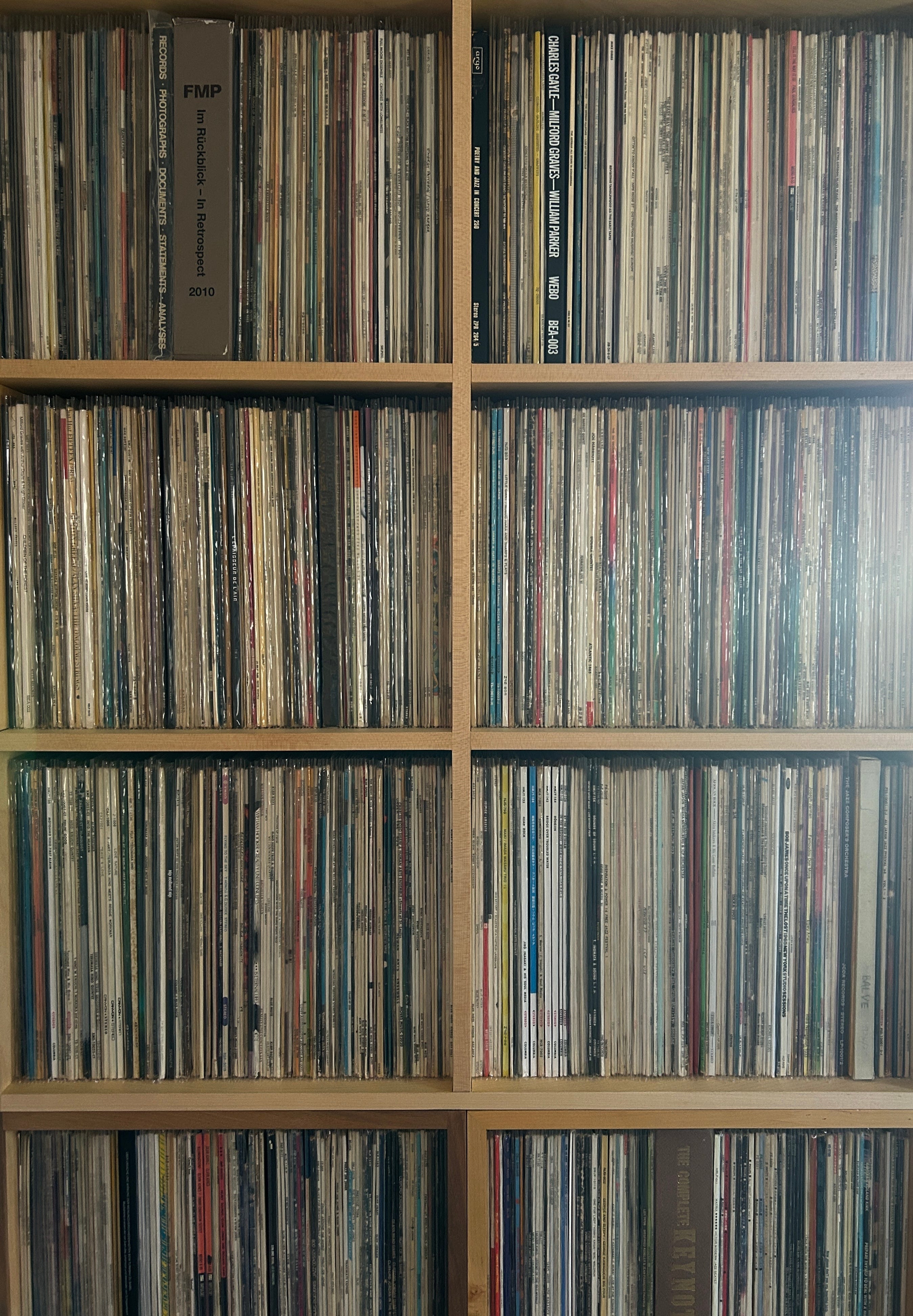
no room for Hawes
I wouldn’t say that vinyl sounds better, looks better, or tastes better than another format, but it is strangely addictive. Part of that is visual: the healthy-sized square is appealing, there are often descriptive notes to get lost in, not to mention room for interesting cover art. A 12” record is the right shape to (carefully) handle, and the labels look cool; 7” singles were never my thing, really, but I’ve accumulated some as well. At one point it seemed that singles weren’t conducive to improvised music, given the short playing time per side, but they can lend themselves to concise, unique performances (the FMP singles and the Instant Composers’ Pool/Misha Mengelberg-Han Bennink flexi disc set are cases in point). 10”s are something I try to minimize because, in the words of Academy Records’ Mike Davis, they are “the devil’s format:” awkwardly too small to shelve with LPs and too big to stuff anywhere else. I’ve always been single-minded and compulsive when I get interested in something: music, cycling, writing projects, railroadiana, so it’s no surprise that records became an obsession and even though I am somewhat less driven now, the fruits of frenzied, fascinated acquisition surround me, walls and walls of uncommon and arcane recordings, most in fine condition. I’ve also found myself listening to more music digitally as, frankly, I don’t have the room or funds to own a file copy of everything I want to hear.
When I started reviewing albums in grad school I found it easy, given how much my ear was attuned to what I’d heard on the stereo and in person, to compare music on a new disc with what had come before—not always accurately, mind you, but it was a healthy place to start. Records lent themselves to constant reassessment, so in a sense I was already reviewing them before I started writing about them; with art-historical formal analysis as a model, giving a recording context and exploring what the music does and how it operates were codified early. What I would eventually learn is that while most musicians are tuned in to a wide range of sounds, far fewer are insatiable record collectors and something I notice in their playing could be a spurious correlation (for example, comparing saxophonist Michaël Attias to John Tchicaï is probably unfair to both, though there may be some parallel phrases that turn up). Writing about live events was always different, though I could call up the immediacy of a first-time listen and familiarity with the form to extrapolate into something more lasting. As an interviewer, knowing an artist’s discography has always been important, though their process has always interested me far more than recounting a laundry list of sessions (not to mention that in some cases, the sessions that didn’t get released can be more intriguing than those that did).
It’s hard to re-capture the excitement of early exposure to cornerstone records: the heaving drone of the title cut to trombonist Roswell Rudd’s Everywhere (that tune composed by Woody Herman/Stan Kenton-associated trombonist Bill Harris, reimagined as a free house of mirrors) or the shock of Albert Ayler’s Bells, which I was turned onto by a record store clerk in Lawrence, KS, and never looked back from. A few years later I remember blind-buying English guitarist Ray Russell’s June 11, 1971: Live at the ICA as a 2CD set and being so blown away by it I had to seek out the original vinyl. I’d listened to Derek Bailey and Sonny Sharrock but this was a very different thing; wiry and gleefully unhinged within an elegantly-arranged framework. The minimally abstract red and green cover design by RCA ad man Olav Wyper was a nice visual touch as well. I had the opportunity to interview Ray over email, a kind and interesting fellow whose music should be heard by more ears, still. Similarly, curiosity led me to Japanese drummer Masahiko Togashi’s 1969 LP We Now Create; and the floodgates eventually opened to a world of Japanese jazz and free improvisation. We Now Create is a beautiful statement of intent with early and formidable appearances by guitarist Masayuki Takayanagi (why reissues of his records don’t fly off the shelves I’ll never understand), bassist Motoharu Yoshizawa, and reedist Mototeru Takagi, its handsome jacket displaying a painting by Togashi himself. Having the experience of an artistic statement flooring you is too rare these days, especially as we are continually saturated by, well, everything.
Building up a stash/archive of albums and discs and the process of occasionally “trimming the garden” (as reedist Mats Gustafsson terms it), because most of us can’t keep it all, is a curious one. I was thinking about it this morning because at one point I decided that I did not have the need/room for the small clutch of LPs by pianist Hampton Hawes that I owned. A couple I enjoyed, a few others I did not connect with and had purchased mainly because they featured drummer Bruz Freeman, brother of Chicago saxophonist Von and guitarist George, and uncle to saxophonist Chico Freeman. Alvin Fielder pushed me to listen to more Bruz (based in Los Angeles, Freeman was in the crucial west coast avant-garde quartet of trumpeter Bobby Bradford and reedist John Carter). Hawes never really grabbed me (that’s a “me” thing and was never the musician’s problem!) so I purged the records but now, reading about how he influenced a number of Japanese jazz pianists including Yosuke Yamashita and Toshiko Akiyoshi, I feel like maybe I was too hasty. Of course, the H section is crammed pretty tightly so I may just have to revisit these sounds digitally. Maybe I’ll hear something I hadn’t heard before, which is the reason, luxury, and curse of having a large physical listening library—it’s all there for reevaluation as time and space allow. The immediate impact of a sound is one thing, but the gradualness of coming to appreciate a work is highly underrated.
—
Creative Musician Birthdays, Dec. 22:
Ronnie Ball, pianist, 1927-1984
Masayuki Takayanagi, guitarist, 1932-1991
Joe Lee Wilson, vocalist, 1935-2011
Nick Ceroli, drummer, 1939-1985
Beb Guérin, bassist, 1941-1980
Warren Benbow, drummer, 1954-2024
John Patitucci, bassist, b. 1959